This guest post was written by volunteer and supporter Michelle Burack
Did you know that one third of the MK Gandhi Institute’s operating budget comes from individual donations?

The MK Gandhi Institute’s important, foundational work– propagating nonviolent communication skills, engaging in restorative practices, advancing racial justice, and promoting sustainability– falls squarely in the domain of “the Common Good”. The concept of the Common Good focuses on shared benefit (as distinct from private goods that benefit only specific individuals), aiming to create the social conditions that allow all individuals to reach their full potential.
Anthropologist Margaret Mead is anecdotally attributed with highlighting a 15,000 year old healed femur as the earliest evidence of human civilization*, foregrounding empathy and communal care as a defining feature of our species. The political climate of 2025 seems to be trying to shift our collective thinking about how (or even whether) society should fund the Common Good, but we know that empathy is a strength of our species, not a weakness. Together we can choose to sustain the Common Good.
What is the most effective way to pool our resources and sustain the Common Good? Do we fund it through taxes and financing of government programs? Or do we rely on charitable donations and religious organizations to carry the weight? As political pressures are incentivizing institutions to pull back from partnerships with organizations that engage in equity and sustainability work, can we step up and help fill the gap as individuals?
Responding to Uncertainty
Because of shifting political sands, The Gandhi Institute is in greater need of individual donations to not only sustain its ongoing work but also build a financial cushion that can help it withstand the current climate of uncertainty. As I look for ways to fight despair, I am leaning into engaging with the experiment that this moment seems to be asking us to conduct: How might I grow my charitable donations in response to the slashing of taxpayer-funded programs? Do I do it reactively, such as donating to food banks when SNAP benefits are threatened? Or can I be more proactive?
A Personal Framework for Giving
Several years ago, I tried to bring some structure to our family’s reactive, haphazard charitable donation practices by making a spreadsheet listing all of the organizations we had donated to in recent years, and adding several organizations that were on my radar that we hadn’t given to yet. I tried to create a weighted priority score that considered the scope of impact–both geographic and number of individuals impacted–as well as the nature of the work in terms of durability of impact and whether the needs were foundational, like food and shelter, or higher on the hierarchy of needs, like arts and education.
It was less an empirical tool than a method for being reflective about what captured our attention, and it did shift our habits toward formulating more concrete goals for a total annual budget for charity and reprioritizing how we directed those funds. In particular, when I compared the US average of 2-4% of annual income for charitable giving to the religious practice of tithing (which is often benchmarked at 10%) it gave me a framework for calculating what our family’s contribution to the Common Good might look like.
Leveraging the Iceberg Model
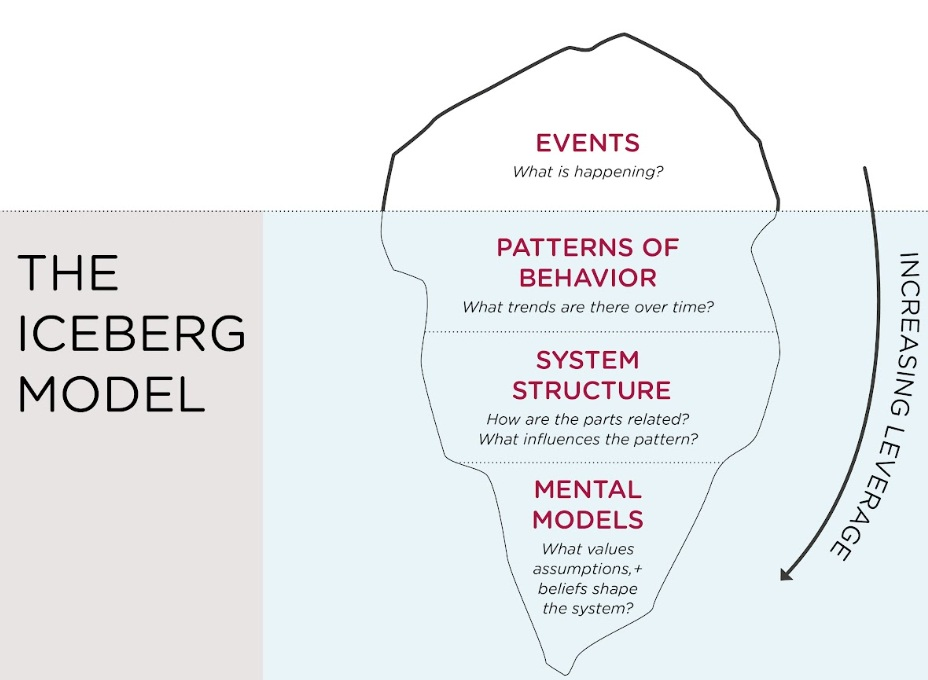
More recently, I have incorporated the “Iceberg Model” into helping prioritize donation decisions. I learned about this model from workshops at the Gandhi Institute; it is a framework that helps connect events and phenomena to their deeper underlying roots. The closer to the base of the iceberg, the greater the leverage for change. Because the Gandhi Institute is working at the level of mental models (i.e. nonviolence), it is a high-priority organization for our family’s donations.
The Power of Timing
The timing of donations also can have an impact. “Giving Tuesday” is a social media event launched in 2012 by the United Nations Foundation and 92nd Street Y as a counterpoint to the individualistic commercialism of Black Friday and CyberMonday, elevating giving and community-building as part of the post-Thanksgiving holiday economy. The movement rapidly grew to a worldwide event, with $3.6 billion donated in the US in 2024. (By comparison, US consumers spent $11.8 billion on Black Friday and $13.3 billion on CyberMonday in 2024). Giving Tuesday donations constitute nearly one tenth of total annual donations, and over a third of charitable giving occurs in the month of December (with 5 percent occurring on December 31st, presumably as a last-minute endeavor to secure tax benefits). One-time donations are always welcome, whereas a monthly contribution can help reduce some uncertainty in an organization’s budget planning.
What motivates you to donate, and how do you decide which organizations to fund? As you shop for the holidays, are there friends and family who might appreciate the Gift of Peace this year, in the form of a donation to the Gandhi Institute in their name?